
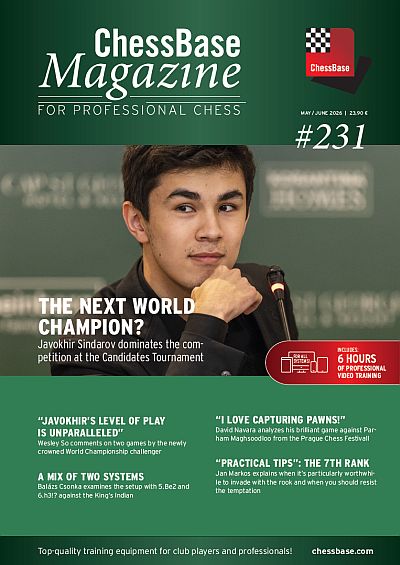
6/25/2026 – ChessBase Magazine offers a window to the world of professional chess. Nagesh Havanur takes a look at the current issue, CBM 231. 2836 games, mainly from the Candidates Tournament and European Individual Championship. 27 annotated, 11 opening surveys, 3 opening videos, demo. lectures and several exercises for training. Annotators include Anish Giri, Wei Yi, Wesley So, Karsten Mueller and Vaishali Ramesh Babu among others. The icing on the cake is the Special feature on Magnus Carlsen offering 20 annotated games.
Review by Nagesh Havanur
The world loves the young. They have a sunny temperament. They remain happy and make others happy. They do have disappointments, but forget them soon. They recover their spirits easily, thinking “Tomorrow is another day.” It keeps them going. Young Sindarov is a shining example. The major part of this issue is devoted to his performance and how he overcame resistance from his rivals. Quite a few observers found it hard to believe, though. “Surely, an experienced campaigner like Caruana stood a better chance.” So they thought and they were proved wrong. In this issue Yannick Pelletier annotates the critical encounter that set Caruana behind in the race. First, let us see the encounter “live”:
Here is the game itself with analysis by the Swiss grandmaster:
Caruana had an opportunity to level his score with Sindarov in the second half of the tournament. He missed it after a careful defence by his opponent. This particular game is not annotated in the issue here. However, one may find with a detailed commentary by Jonathan Speelman on the ChessBase News Page:
In a recent interview Sindarov explained how he had a lucky start.
Every game was very important, but probably one of the most important games was the first game (against Esipenko) where I played very badly and my time management was also very bad. I was very closing to losing this game, I was being outplayed. But at one point I got lucky when he quickly played a bad move and I got some small chances. After that I started playing very fast and was lucky to win this game. And you know, in my opinion, when you start the tournament with a lucky break like this, it’s always one of the biggest steps to win a tournament. One of the biggest steps was made in the first round.
At first sight the game does not make sense at all. Surely, Esipenko was “winning” the pawn on d4 and why did he have to sacrifice the exchange? Was he really in such danger? In my annotations to the game here I have offered a few signposts.
In the second half of the tournament, Wei Yi did set problems for Sindarov and here is how he overcame the Chinese grandmaster. The game is annotated by Wesley So in this issue.
Wei Yi-Sindarov Candidates’ Tournament 2026
The game between Caruana and Giri saw fluctuating fortunes and the winner annotates the encounter in this issue:
Vaishali annotates her game with her compatriot, Divya Deshmukh
I would have loved to see her annotations to her decisive win over Kateryna Lagno in the last round:
Vaishali,Ramesh Babu-Lagno,Kateryna, Candidates’ 2026
This issue also includes games from the European Individual Championship won by young Roman Dehtiarov with a score of 9/11 points ahead of Nijat Abasov, Aydin Suleymanli and Muradli Mahammad who were half a point behind. I would have loved to see a few annotated games here.
One game that fascinated me was the following encounter:
A magic display with quiet and subtle moves that would have delighted the Hypermoderns
A Magnus Special
The issue has a special feature on Magnus Carlsen who is still ranked the Number One player in international chess. There are 20 annotated games from the world championship period, 2014-2023.* His opponents include veterans like Anand & Ivanchuk and younger talents like Firouzja and Keymer among others. Here is a remarkable miniature against one of the leading grandmasters:
Opening videos
There are 3 opening videos in this issue. The first of them is by. Jan Werle who deals with a side line 5…a6 in the French Defence, Tarrasch Variation (C08). The second is by Mihail Marin who analyses a well-known line of the Italian Game (C53). The third is by Danny King who explores a new idea, 6…a5 in the Catalan (D06).
Take your pick.
Opening Surveys
There are as many as 11 articles on the openings ranging from the Sicilian to the Slav. Among them I would single out Petra Papp’s commentary on the 4.Nge2 Line of the French Winawer Variation and
Robert Ris’ work on an unusual line in the Queen’s Gambit Accepted.
In her analysis on the 4.Nge2 Line of the Winawer Variation (C15) Petra Papp makes a case for the less known 7. Bf4 move. But I still prefer 7.d5 that sets more problems for Black. Here are her annotations to this line.
Why not 7.Bf4? It allows the immediate 7…Nf6 preparing …Nd5 racing to protect c7.
Perhaps the most challenging line against the Winawer is 4.Bd2!? Admittedly, it is well -analysed. It still needs a second look.
The other is an analysis of an offbeat line in the Queen’s Gambit Accepted by Robert Ris. I have added a little more explanations for readers not familiar with opening theory.
Besides opening surveys, this issue has standard features on tactics, strategy and the endgame.
I was particularly impressed by Dorian Rogozenko’s presentation of an old game, Kasparov-Anand 1996 in the Euwe Memorial Tournament, Amsterdam 1996. Many modern experts tend to see these games through the lens of engines and are often dismissive of the quality of play. Rogozenko is different. He is well-aware of the nuances of current opening theory and how Fritz can demolish old analysis. What he does is to find out how players think and why games are won and lost. Now let us return to the game.
1996 was Veselin Topalov’s year. He won tournament after tournament. It also happened in the Euwe Memorial Event in Amsterdam. He inflicted a painful defeat on Kasparov in the first round followed by a victory over Anand in the second round. Garry had recovered from his loss in the first round and beaten Piket in the second round. In the third round he met Anand. Vishy had lost to Kasparov in the world championship match in the previous year. Here in this tournament he had yet to recover his form. In the following game he fell to Garry on account of his superior opening preparation and greater understanding of the middlegame strategy à la Nimzowitsch.
I have resisted the temptation to offer Rogozenko’s commentary in this issue. Readers can draw their own conclusions after they have seen the video.
By way of postscript, I may add, Garry shared the first place with Topalov in the tournament. Vishy did not do badly, sharing third and fourth place with Nigel Short.
Endgame Play
In the regular column “Fundamental Endgame Knowledge” Karsten Müller offers a video lecture on endgames with queen versus rook. For starters, he offers a position from Philidor:
Philidor: jpeg image
This is followed by his exposition of a series of positions with the king and queen versus the rook and pawn.
In a separate section he analyses 18 endings played by Carlsen who is known as a virtuoso in the final phase of the game.
This section also offers a column, “Readers write” in which we find contributions on the endgame by experts, Zoran Petronijevic, Wolfram Schön and Jana Schneider among others.
Summing up
The main database of the issue has 2836 games of which 27 are deeply annotated. There is much else in this DVD that deserves to be explored. Apart from the players I have already mentioned, the commentators include Baskar Adhiban, Michal Krasenkow and Yevgeny Postny among others. It may be noted that there are more annotated games in the opening and training sections of this issue. Well, practice makes perfect.