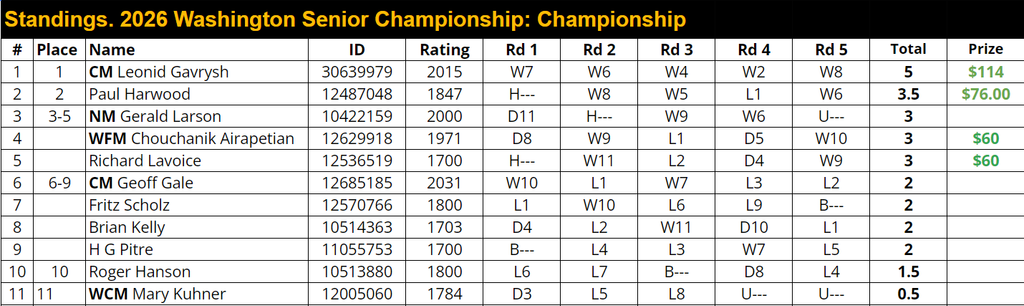
2026 Washington Senior Chess Championship – ROUND 5
Round 5 of the 2026 Washington Senior Chess Championship. It is 3 PM. I have just lost a crushing game in round 4, and now I am sitting across from Geoff Gale, rated 2031, who beat me to the punch by playing the Maroczy Bind. I have Black. I am tired. I have 150 rated points less than my opponent.
Somehow, I win in 27 moves.
This is the story of how that happened, what went wrong for White, and the lessons every club player can glean from it.
Maroczy Bind Basics: What You Are Up Against
The Maroczy Bind arises out of the Sicilian Accelerated Dragon after 1.e4 c5 2.Nf3 Nc6 3.d4 cxd4 4.Nxd4 g6 5.c4. White plants pawns on e4 and c4, strangling the center and denying Black the typical Sicilian pawn breaks on b5 and d5. It is a slow suffocation strategy. White wants space. Black wants air.
I had done some opening preparation for this exact line, which helped. Geoff played 6.Be3 Nf6 7.Nc3 followed by Be2, O-O, and h3 before the game got genuinely interesting.
Lesson 1: Trade the Knight, Keep the Tension
On move 10, I played Nxd4, exchanging knights and releasing some central tension. This is a very common approach in the Maroczy Bind as Black. Trading a knight relieves the spatial squeeze, since every piece swap works in the cramped side’s favor. Silman’s imbalance framework puts it plainly: if your opponent has a space advantage, piece trades are your friend. After Bxd4, White’s powerful d4 knight is gone and we have a more manageable position.
Lesson 2: The Queenside Pawn Push Is Not Optional
After 12.Qc2, I played a5. This is a thematic idea in the Maroczy Bind. Gaining space on the queenside is how Black counterbalances White’s central grip. The pawn on a5 restrains White’s b-pawn and sets up future pressure. If you are playing Black against the Maroczy Bind and you forget to push a5, you will spend the rest of the game wondering why your pieces feel like they are stuck in traffic.
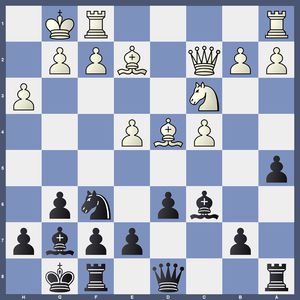
Lesson 3: An Unusual Move Deserves a Long Think
On move 17, Geoff played Nb5, which is about as rare a knight move as I have seen in this line. My first instinct was suspicion. Does he know something I do not? After a 15-minute think, I decided he had just hung a pawn. So I took it with Bxe4. A pawn is a pawn, and at the club level there is nothing wrong with that philosophy, as long as you have checked the position carefully.
The key was not panicking at the unusual move. When your opponent goes off-script in a Maroczy Bind position, resist the urge to react immediately. Sit on your hands, evaluate the compensation being offered, and only then decide.
Lesson 4: Active Rooks Win Games
After some maneuvering, I played Rc5, which I was genuinely pleased with. The rook centralizes, threatens to double on the c-file, and creates lateral pressure across the 5th rank. My rooks suddenly had purpose and influence. White’s forces, by contrast, were looking for a role they never found.
This is the Silman principle in action: rooks belong on open files and central ranks. A rook on c5 creates problems. A rook sitting on a1 or e1 without a plan accomplishes nothing. Active rook placement was the single biggest reason the position started tilting in my favor.
For more on rook activity and piece coordination, this article on betterchess.net covers the fundamentals well: betterchess.net/chess-game-analysis/tournament-chess/
Lesson 5: Double-Check Before You Sacrifice
On move 26, White played hxg6, which I recognized as a blunder. Then came the real mistake: Rxe5, which lost on the spot. White had calculated that after dxe5, the queen could swoop to g6 with check, winning material and probably the game. The problem? After dxe5, my queen on f4 was covering g6. The entire combination collapsed. White resigned immediately.
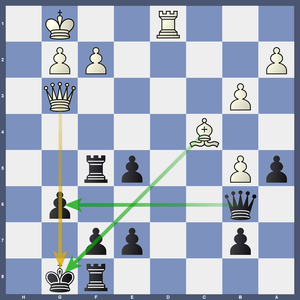
There is an old rule: when you spot a brilliant combination, look one move deeper. White missed one defensive resource, and a 2000-rated player handed a 1847-rated player a win in 27 moves.
3 Key Takeaways
- Trade pieces when cramped. In any Maroczy Bind, piece exchanges are a Black strategic weapon. Every swap reduces White’s spatial advantage.
- Push a5 early. The queenside pawn advance is not just helpful in the Maroczy Bind; it is mandatory. Delay it and you will suffer.
- Activate your rooks before combinations appear. Good rook placement creates opportunities. Passive rooks let your opponent create them instead.
Further Study
For a deeper dive into the Maroczy Bind from both colors, the analysis at Chess Strategy Online is an excellent reference, with annotated grandmaster games that illustrate all the key plans clearly.
Tournament complete
After this game, the tournament was over. I was very close to taking down the leader. Let’s see what happens next year!